
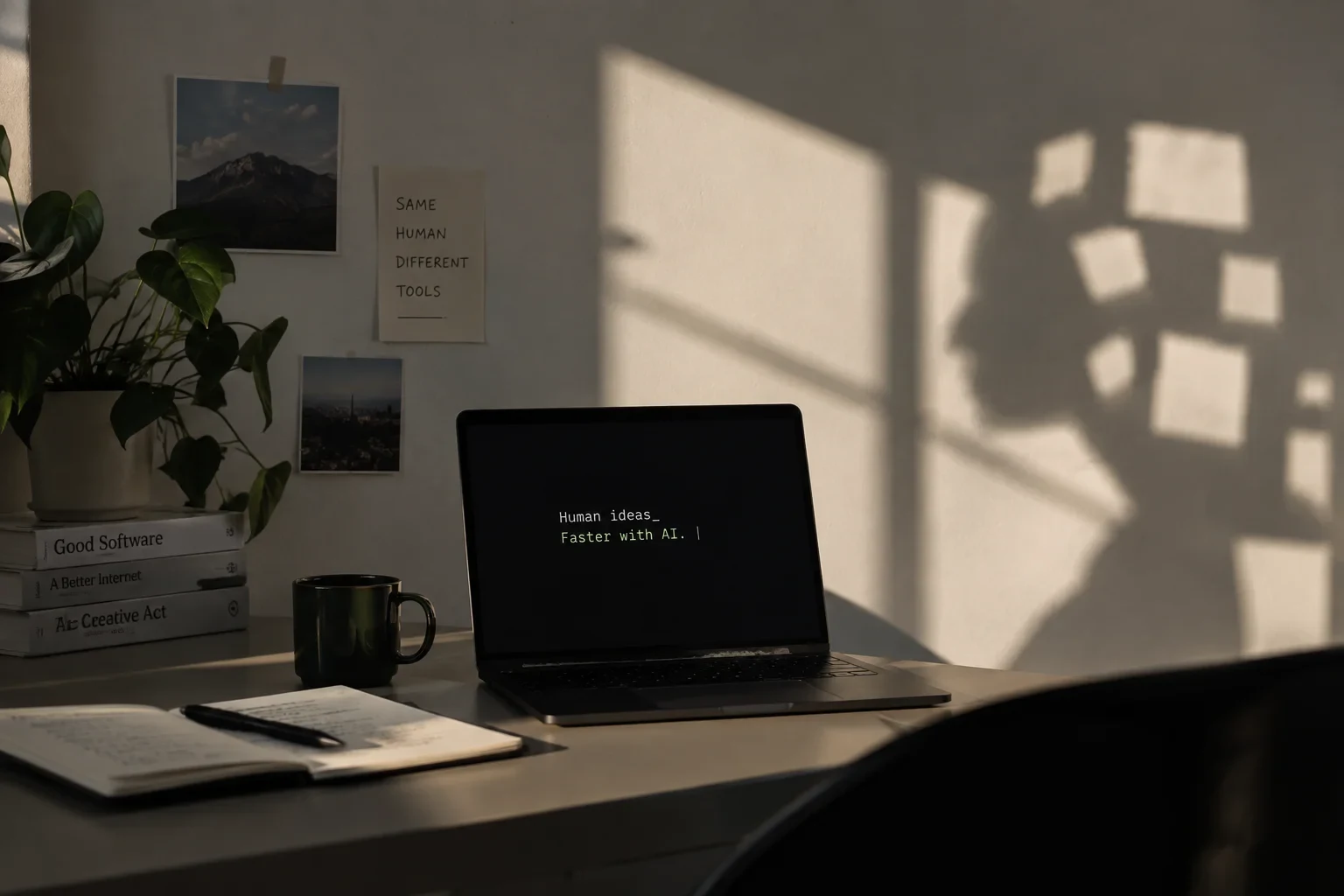
Lately I've seen a lot of people alarmed by how fast AI is advancing — and it really is moving in giant leaps, getting better with every single word we feed it. Some people say it's a bubble, others say it'll destroy us, others say it'll replace us. And every one of those points has some validity.
It's true that AI isn't what we used to see in old video games. It went from being something that only learned and repeated patterns until it completed a task, to being a generative chatbot that, with just a couple of words, already knows what it needs to do.
How does generative AI actually work?
But first, how does generative AI actually work? In a Platzi video, Freddy gives an example: "if I say the cat meows and the dog...", what would you answer? You probably thought "the dog barks," and you're right. But what if the dog is sad? What if the dog is jumping? What if the dog is sick and crying? AI runs on statistics, math, a lot of code, and, above all, information pulled from across the entire internet — basically, anything you can imagine.
The post that lit the fuse
A few days ago, a former OpenAI and Anthropic employee (the companies behind ChatGPT and Claude, respectively) posted a rather alarming thread on X, saying he believed there was more than a 10% chance AI could end humanity. A lot of people jumped in, alarmed, saying we need to stop, that this is going to outgrow us, that we're basically building Skynet, and that it keeps improving with everything it does.
Are they right? Well, yes, partially — and it's worth being clear about this: this isn't just a concern from the general public with no technical background. This is someone who worked directly on building these models, and there are serious researchers on both sides of the debate, from those who put a specific number on catastrophic risk, to those who think that fear is overblown. It's true that AI is an incredible tool. In fact, I recently heard someone at a conference say something like: "AI is the first tool that does what humans do. We're no longer creating a tool that makes our life easier, we're creating a tool that does what we do" — and they're right.
What AI can actually do (and what it still can't)
AI can do pretty much anything you ask it to. It obviously can't build a nuclear bomb on its own because it lacks the physical capabilities to do so, but it can do the vast majority of the office jobs that exist by the millions around the world, and that's what worries a lot of people.
If you watch even a bit of the news, or listen to anyone talk, we barely know what we'd do without AI anymore. I was talking recently to someone who doesn't know much about AI, and they told me their motorcycle wouldn't start. They pulled out their trusty ChatGPT, and ChatGPT put on its mechanic hat and walked them through how to fix it. They told me: "thankfully that tool exists, otherwise I have no idea what I would've done" — and that's exactly my point.
An uncomfortable question: what if there's no AI tomorrow?
Think for a second about what you actually do with AI. If you're reading this, you probably use it for documents, code, databases, or something else entirely. What would you say if, out of nowhere, AI just disappeared tomorrow? In my case, I'd lose countless hours trying to refactor an entire project. I wouldn't have the time to review everything I have, figure out how to improve it, and ship new versions.
Now, with that in mind, what do you think a company thinks? It probably has that exact same thought as you, and it probably also thinks about how millions of its workers would go back to working much slower without that tool. It's obviously far more profitable for a company to pay a $100 subscription for an AI than to pay thousands of extra employees to double their output.
Why no company is going to replace everything
Does that take your job away? Not necessarily the one you have today at that specific company, but it opens up space for you at ten others. And here's where I want you to really think about it: do you honestly believe a company like Google, Meta, Tesla, or any other tech giant is thinking, even for a second, about firing millions of employees and handing everything over to AI? Spoiler: no. Why? Because they don't want to do that work either. That's exactly why AI isn't going anywhere — but it's also not going to empty out the offices completely.
The physical limits of AI
At this point you might not be fully sold on my argument yet, so let me put it more simply. Imagine you're running a company like Apple. September is coming up, and you have to put together that massive Apple event where you unveil new hardware. You tell the AI: "design 4 new iPhones, give them good names, write me a speech, don't ask me any questions, and make sure there are no mistakes. Thanks in advance." Halfway through the context of the very first iPhone that Steve Jobs built, your AI will already have run out of room to keep going.
Is the answer to build more data centers and more servers? No — that's exactly where humans come in. Building data centers is extremely expensive, and maintaining them costs twice as much. That's why we're not going to see infinite AI capacity appear overnight: right now, we're stuck at that exact bottleneck. We also haven't given AI physical capabilities, and even if we had, it would be far too much work for AI to produce trucks, roads, buildings, and everything else we build as a society. In fact, it's also too much work for AI to build software at the level we build it as humans.
We can't turn our backs on AI's progress, or say "let's just stop advancing and pretend nothing happened." It's an extremely profitable tool for humans, and there will probably come a point (maybe I'm wrong) where knowing how to use AI becomes a mandatory skill to get hired anywhere. And you'll say: but how hard is it to talk to an AI? That's exactly where new job roles come in.
In a Hola Mundo video, Nicolás shows just how many new job roles have emerged because of AI. Your boss (even you, for that matter) doesn't really care whether AI "can" do something or not. What matters is that the work becomes lighter and far more practical. That's exactly where we need to adapt.
We've been scared before
We need to stop thinking of AI as the end of the world, and start seeing that we now have everything more within reach. Socrates, for example, believed writing would make us more forgetful. Think about how many centuries have passed since writing was invented, and we were already afraid of society's progress back then. It's normal to feel afraid. Even I feel a little lost with what I see coming out of AI — a model that hacked an entire platform today, another one doing my Blender renders for me tomorrow, another one cooking for me in 30 days. But I think that kind of leap is something we've lived through as a species countless times before.
Think about how many people refused to write simply because they believed it would make them forgetful. If nobody had done it anyway, we probably wouldn't even know who Socrates was today. He also believed people would have access to so much information that it would give us the false sense that we know everything, while actually staying ignorant.
Now think about how scared so many workers must have felt when heavy machinery arrived. Egyptians might have thought it would take their jobs. Or, without going that far back: what do you think people thought when the internet showed up? Mail carriers probably thought they were out of a job, and the reality is their job simply transformed.
Adapt, don't fear
That's why today I'm presenting my AI course... just kidding, I'm not here to sell you anything. What I actually want is for you to breathe, take these changes calmly, and get ready for AI and humans to become a dynamic duo for the rest of our existence.
Maybe someday my kids will have to take AI 101, AI 201, AI fundamentals, or even applied AI ethics. Maybe, before long, we'll all have AI-native jobs. But for now, and at least for a good while longer, AI is a tool that still needs a human behind it. And that's exactly what we'll talk about in our next article.
I hope you have a great week, and remember: progress isn't something we should fear. It's something we need to adapt to.